



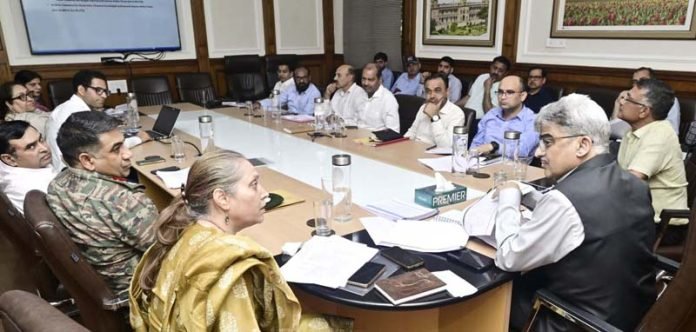
Chief Secretary Atal Dulloo chaired a high-level meeting to assess the progress of National Highway projects across the Union Territory, issuing firm directives to ensure their timely completion while minimising public inconvenience.
The meeting was attended by senior officers, including Principal Secretary Agriculture Production Department, Shailendra Kumar; Commissioner Secretary, Forest, Ecology & Environment, Sheetal Nanda; Secretary, Public Works (R&B), Bhupinder Kumar; and Divisional Commissioner Jammu, Ramesh Kumar. Other officers participated online. Representatives from key agencies such as the National Highways Authority of India (NHAI), National Highways and Infrastructure Development Corporation Limited (NHIDCL), and the Border Roads Organisation (BRO) were also present.
The Chief Secretary reviewed various National Highway projects, including the Delhi-Amritsar-Katra (DAK) Expressway, four-laning of Banihal Bypass, Srinagar Ring Road, Jammu-Akhnoor National Highway, Chenani-Sudhmahadev Road, Khellani Bypass Tunnel, and projects under Project SAMPARK. He scrutinised the progress of individual packages, scheduled completion dates, and financial status, directing the NHAI to expedite work while ensuring minimal disruption to the public.
“Delays are unacceptable. We must prioritise efficiency and public convenience in equal measure,” Dulloo asserted. He also highlighted the region’s challenging topography and urged proactive planning to mitigate weather-related and natural obstacles. Additionally, Director Geology and Mining, Suraj Parkash Rukwal, was tasked with ensuring that mining activities do not hinder progress, while forest clearance issues were discussed with Commissioner Secretary Sheetal Nanda.
In another key meeting, the Chief Secretary reviewed the draft Jammu and Kashmir Hydro Power Policy 2025, underscoring the Union Territory’s vast potential in hydropower generation and its role in economic development. The policy aims to attract private investment by restructuring the existing framework. It proposes classifying hydroelectric projects into two categories: Small Hydroelectric Projects (up to 25 MW) and Large Hydroelectric Projects (above 25 MW and up to 100 MW). The Jammu and Kashmir Energy Development Agency (JAKEDA) will oversee projects up to 10 MW, while the Jammu and Kashmir Power Development Corporation Limited (JKPDCL) will manage those above 10 MW.
During discussions, the Chief Secretary stressed the importance of reducing power losses, which he described as a major drain on resources. The meeting, attended by Principal Secretary Power Development Department, H. Rajesh Prasad; Principal Secretary Finance, Santosh Dattatraya Vaidya; Managing Director JKPDCL, Pankaj Magotra; and Managing Director Jammu Power Distribution Corporation Limited (JPDCL), Ch Mohd Yasin, focused on finalising the policy framework to harness Jammu and Kashmir’s hydropower potential and attract investment.
The UT administration will also consult stakeholders before finalising the policy, ensuring a collaborative approach to sustainable development.
