



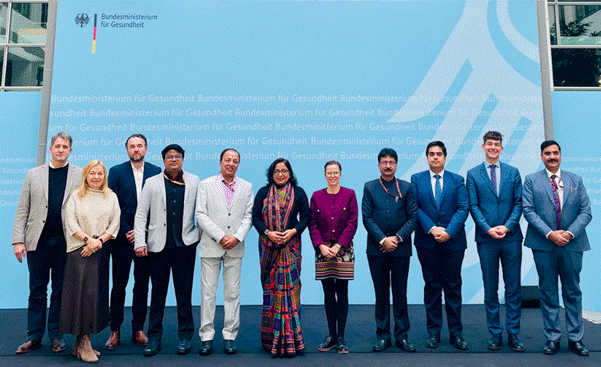
The 3rd Joint Working Group (JWG) Meeting on Alternative Medicine, held from November 18 to 20, 2025, in Berlin, witnessed India and Germany elevate collaboration in the domain of traditional medicine. The meeting, led by the Ministry of Ayush, Government of India, in partnership with the Federal Ministry of Health, Germany, marks a pivotal moment in the advancement of integrative healthcare practices across both nations.
The Indian delegation, spearheaded by Ms. Monalisha Dash, Joint Secretary of the Ministry of Ayush, comprised prominent figures in the field, including Prof. (Dr.) Rabinarayan Acharya, Director General of CCRAS, Dr. Subhash Kaushik, Director General of CCRH, and Dr. Koustabha Upadhyay, Adviser, Ministry of Ayush. Germany’s representation featured Paul Zubeil, Head of Division for European Health Policy, along with distinguished experts from Charité Berlin and the Federal Institute for Drugs and Medical Devices (BfArM).
The focal points of the meeting included three primary themes: integrating traditional medicine into public health systems, establishing reimbursement pathways for patient access, and fortifying regulatory approval mechanisms. These key areas underline the mutual commitment of both countries to promote evidence-based traditional medicine practices that prioritize patient care.
Additionally, the visit allowed significant discussions with the Competence Center for Traditional and Integrative Medicine at Charité University, aiming to advance collaborative research initiatives. This involves further deliberations on a proposed Memorandum of Understanding (MoU) between the Ministry of Ayush and German institutions.
At the Community Hospital Havelhöhe, known for its focus on anthroposophic medicine, participants examined integrative care models in practice. Detailed talks with the Federal Joint Committee (G-BA) specifically targeted insurance and reimbursement provisions relevant to traditional medicine, a critical factor in enhancing patient access.
This diplomatic mission represents the Ministry of Ayush’s broader strategy to internationalize Ayush systems, emphasizing the formulation of robust frameworks for integrating evidence-based practices. Furthermore, it aims to establish high-value partnerships that expand India’s presence on the global stage for traditional medicine.
The Ministry expressed optimism that fostering collaboration with Germany will expedite research initiatives, streamline regulatory processes, and broaden access to safe, high-quality integrative healthcare solutions anchored in scientific validation.
As the world increasingly recognizes the benefits of traditional medicine, both India and Germany are poised to play vital roles in shaping its future. This partnership resonates with the growing demand for holistic treatment options, encapsulating a shared vision of health and well-being.
