



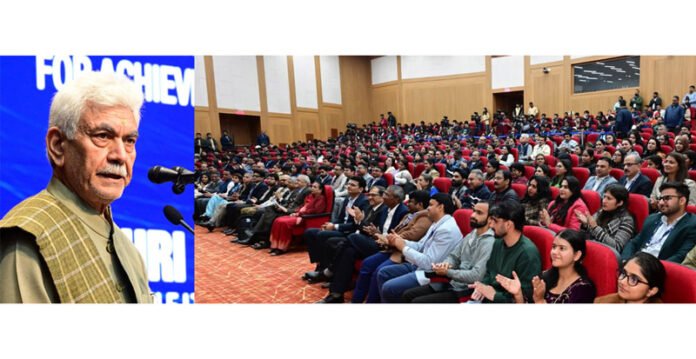
Lieutenant Governor Manoj Sinha announced on Monday that large parts of India, especially the northeast, have been freed from terrorism. He highlighted the dramatic drop in local recruitment into terrorist groups in Jammu and Kashmir (J&K), stating that less than a handful of youths are joining these ranks.
Speaking at the Strategic Management Forum (SMF) Conference at the Indian Institute of Management (IIM), Jammu, Sinha addressed key security issues while outlining the country’s vision for achieving Viksit Bharat by 2047.
“Except for a few pockets, most areas in the northeast are now terrorism-free. The once severe threat from left-wing extremism and Naxalism has diminished significantly,” Sinha confirmed.
He noted that remaining hot spots of terrorism have been isolated to only two or three districts, with effective countermeasures in place.
Local Military Situation in Jammu and Kashmir
Delving into the current state of Jammu and Kashmir, Sinha asserted that no prominent terrorists remain operational in the area. Recent statistics show a drastic decline in local recruitment into terrorist organizations.
“Only one or two youths are opting to join these groups now,” he said, emphasizing the importance of concerted efforts to further diminish these numbers.
Despite these achievements, Sinha highlighted the ongoing threat from cross-border terrorism, attributing attempts to infiltrate from Pakistan as significant to the region’s security concerns. He assured attendees that these infiltrators, who find refuge in forests and rugged terrains, will be dealt with decisively.
Further stressing the evolving nature of terrorism, he remarked that educated individuals are increasingly becoming involved. Shifting the onus of tackling terrorism from security forces alone, Sinha noted that society and various administrative sectors must also play proactive roles.
Ending Divisive Narratives
In his address, Sinha urged an end to the divisive “insider-outsider” narrative in public discourse, which he believed hampers developmental progress in vulnerable regions.
Vision for a Developed India
Discussing India’s future, Sinha called on policymakers and business leaders to adopt an inclusive approach, focusing on macroeconomic stability, education investment, digital advancements, and participatory governance. He remarked on Prime Minister Narendra Modi’s leadership role in fostering unprecedented growth.
“Industry leaders now exhibit renewed confidence. Sectors like manufacturing and handicrafts are gaining global competitiveness, driven by the Prime Minister’s call for Swadeshi, which has reinvigorated these industries,” Sinha noted.
Economic Opportunities in Jammu and Kashmir
Highlighting the economic potential of Jammu and Kashmir, Sinha pointed out its vast reserves of natural minerals. He claimed that with strategic planning, the region could generate an additional annual revenue ranging from Rs 15,000 crore to Rs 20,000 crore over the next five to seven years.
He recommended maximizing the hydropower sector’s capabilities and updating the Holistic Agriculture Development Programme (HADP) to meet evolving economic requirements.
Cultural Heritage and Artistic Initiatives
During the conference, Sinha also inaugurated the Basohli Painting Exhibition and celebrated the conclusive session of the Basohli Painting Workshop, acknowledging the artists’ contributions.
“Basohli Painting reflects our invaluable artistic heritage, crucial for both present and future generations,” he stated, complimenting the collaborative efforts of IIM Jammu and the Indira Gandhi National Centre for the Arts (IGNCA).
Notable Attendees
The event drew a diverse group of attendees, including prominent figures such as Prof B.S. Sahay, Director of IIM Jammu; R.K. Chaudhary, Chairman of the Jammu and Kashmir and Ladakh Regulatory Commission; and industry leaders, artists, and students.
