



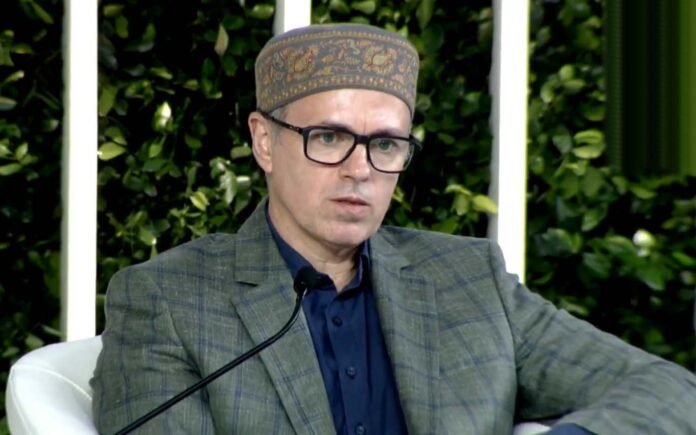
Omar Abdullah, the Chief Minister of Jammu and Kashmir, expressed deep concern over the disempowerment of his office, stating he faces the “unique misfortune” of leading a Union Territory that wields significantly less power compared to a State. Speaking at a national newspaper event in Jammu on Wednesday, Abdullah called for a transparent timeline for the restoration of statehood.
During his address, Abdullah highlighted the challenges stemming from frequent interventions by the Lieutenant Governor’s office which, he claimed, undermines elected authority. He emphasized the urgent need for clarifying a timeline to achieve statehood, a demand he has persistently made amid ongoing political uncertainties.
“I find it very difficult to reconcile the terms ‘Union Territory’ and ‘Jammu and Kashmir’ in the same sentence,” he stated emphatically, showcasing his frustration over the current political arrangement. Abdullah lamented that while officers never emphasized the term ‘State’ during his previous tenure, the status of being a Union Territory is now constantly stressed.
**Power Struggle with the LG Office**
Abdullah pointed to what he described as an asymmetrical distribution of power. He argued that Lieutenant Governor Manoj Sinha has retained roles traditionally associated with an elected government, such as chairing the Jammu and Kashmir Power Development Corporation and convening meetings for tourism promotion.
“What business does someone responsible for security have holding a tourism meeting?” Abdullah asked, critically reflecting on roles assumed by the Lieutenant Governor’s office. He further argued that several cabinet decisions, including modifications to reservation percentages, have languished, unsettled in the Lieutenant Governor’s office.
Abdullah articulated his belief that there exists an unjust power dynamic between the elected government and its unelected counterpart, urging the Centre to heed his calls for immediate reforms.
**Statehood and Article 370**
On the salient issue of restoring statehood, he revisited the three-step process outlined by the Centre, comprising of delimitation, elections, and finally statehood. Abdullah observed, “Two steps are complete. Why are we made to wait for the third?” He challenged the government to specify what is meant by “appropriate time” for achieving statehood.
“If it is when the BJP comes to power, then be honest so people can make informed decisions,” Abdullah argued, underscoring his vocation for transparency regarding the restoration of Article 370. He noted that any such restoration would likely need a change in the central government. “It is pointless to ask the people who took it away from us to give it back,” he continued, affirming his commitment to safeguarding the region’s special status.
**Radicalisation and Governance**
Addressing radicalisation, Abdullah warned that hyper-nationalism and collective punishments contribute to the growing unrest in the region. He sharply criticized the state’s practice of demolishing houses linked to terror activities, stating, “You demolished houses after the Pahalgam attack, only to later find no Kashmiri involvement. If those people are radicalised, whose fault is it?”
Moreover, he cited controversial incidents regarding representation in sports and medical college admissions, where objections arose due to the majority of selected candidates being from the Muslim community. Abdullah stressed that pushing any community to the margins undermines social cohesion and amplifies friction.
**National Politics and EVM Debate**
In the broader context of national politics, Abdullah characterized the opposition INDIA bloc as frequently being in the “ICU” status, alluding to internal struggles that hinder effective opposition to the ruling party. He defended Rahul Gandhi’s silence on critical issues such as Article 370, attributing it to electoral strategy, saying, “I’d like him to win an election before we can have this conversation.”
Breaking from his father’s stance, Abdullah also countered allegations of electronic voting machine (EVM) tampering. He asserted, “We should own our defeats and correct our mistakes,” while placing the blame for electoral setbacks on constituency delimitation rather than on the voting system itself.
**Economic Concerns**
Earlier, Abdullah addressed pressing environmental issues, including pollution and the dry spells affecting Srinagar. He lamented that the valley’s unique geography exacerbates smog challenges. He sought to dispel misconceptions surrounding tourism’s role in the economy, clarifying that it ranks behind agriculture, horticulture, and industrial sectors in terms of contribution to the Gross State Domestic Product.
Omar Abdullah’s candid critique of the political landscape of Jammu and Kashmir highlights a critical juncture for the region, where restoration of autonomy and governance remains a pivotal concern for its residents.
