



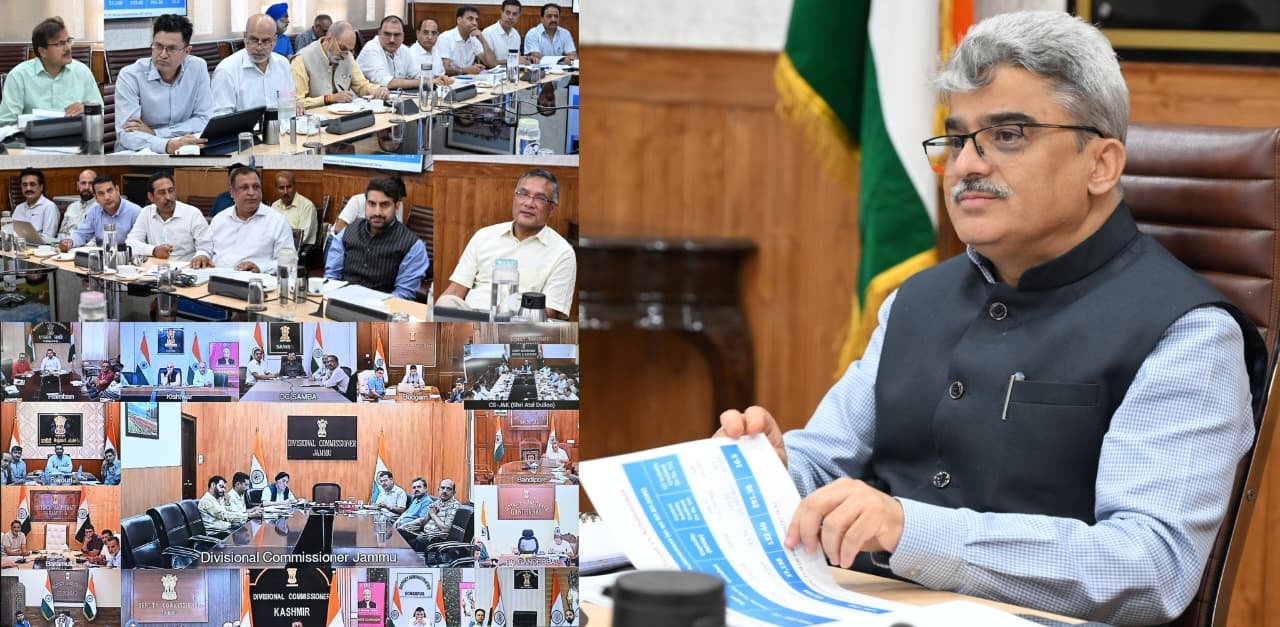
Srinagar, July 9: Chief Secretary Atal Dulloo on Thursday directed officials to accelerate the implementation of the PM Surya Ghar: Muft Bijli Yojana and the Solarisation of Government Buildings Programme, setting monthly targets to ensure timely completion of both flagship initiatives across Jammu and Kashmir.
Chairing a high-level review meeting, Dulloo stressed the need to meet the targets assigned to the two Power Distribution Companies (DISCOMs) within the stipulated timelines. He directed the agencies concerned to complete the installation of rooftop solar (RTS) systems for nearly 57,000 beneficiaries where vendor agreements have already been executed so that consumers receive the benefits of the scheme without delay.
The meeting was attended by Additional Chief Secretary, Power Development Department Ashwani Kumar, Additional Chief Secretary, Finance Shailendra Kumar, Divisional Commissioners of Jammu and Kashmir, Managing Directors of JPDCL and KPDCL, CEO JAKEDA P.N. Dhar, and other senior officials.
The Chief Secretary instructed the departments to prepare a well-defined implementation schedule to achieve the targets well before the sunset date of the PM Surya Ghar: Muft Bijli Yojana, enabling Jammu and Kashmir to fully utilize the opportunities available under the Government of India’s flagship programme.
Reviewing the progress of the government building solarisation programme, Dulloo directed the Science and Technology Department and JAKEDA to expedite execution in mission mode. He set a target of completing rooftop solar installations on over 1,400 government buildings under the CAPEX mode and around 1,300 buildings under the RESCO mode by the end of July 2026.
He also emphasized the simultaneous installation of smart meters in all commissioned buildings to facilitate effective net metering, accurate energy accounting, and optimal utilization of solar assets.
Additional Chief Secretary, Power Development Department, Ashwani Kumar, outlined the roadmap for bridging implementation gaps and highlighted measures to strengthen inter-departmental coordination, simplify operational processes, and accelerate execution of both programmes.
Additional Chief Secretary, Finance, Shailendra Kumar, suggested recognizing districts demonstrating outstanding performance to encourage healthy competition among implementing agencies. He particularly appreciated the progress made in Kupwara and Shopian districts and recommended that officers and field functionaries responsible for the achievements be suitably recognized.
Managing Director, KPDCL, Mehmood Ahmad Shah, informed the meeting that the Government of India has set a national target of one crore residential rooftop solar installations by March 31, 2027 under the PM Surya Ghar scheme. Jammu and Kashmir has been assigned a target of 83,500 residential consumers, including 39,500 under JPDCL and 44,000 under KPDCL.
As of July 7, 2026, rooftop solar systems had been installed for 37,138 residential consumers across the Union Territory, with a cumulative installed capacity of 133.40 MW. Beneficiaries have received ₹291.38 crore in Central Financial Assistance, while the UT Government has provided an additional ₹10.50 crore as subsidy to encourage wider adoption of rooftop solar systems.
CEO JAKEDA P.N. Dhar informed the meeting that Jammu and Kashmir currently ranks third among all States and Union Territories in the number of government buildings solarised. So far, 8,131 government buildings—representing 36.14 per cent of the 22,494 identified buildings—have been equipped with rooftop solar systems.
Under the CAPEX mode, rooftop solar systems have been installed on 3,338 buildings, generating 46.30 MW of capacity against the allocated 65 MW for 5,500 buildings. Materials have already been supplied for 1,462 additional buildings, while supplies for another 800 buildings are in transit.
Under the RESCO model, the government plans to develop 175 MW of rooftop solar capacity across nearly 8,000 government buildings. Work orders have already been issued for 1,360 buildings, with competitively discovered tariffs ranging between ₹4.19 and ₹5.27 per unit.
The Chief Secretary directed all implementing agencies to maintain close inter-departmental coordination, adhere strictly to project timelines, and regularly monitor district-wise progress to ensure that Jammu and Kashmir achieves its solarisation targets within the stipulated timeframe.
