



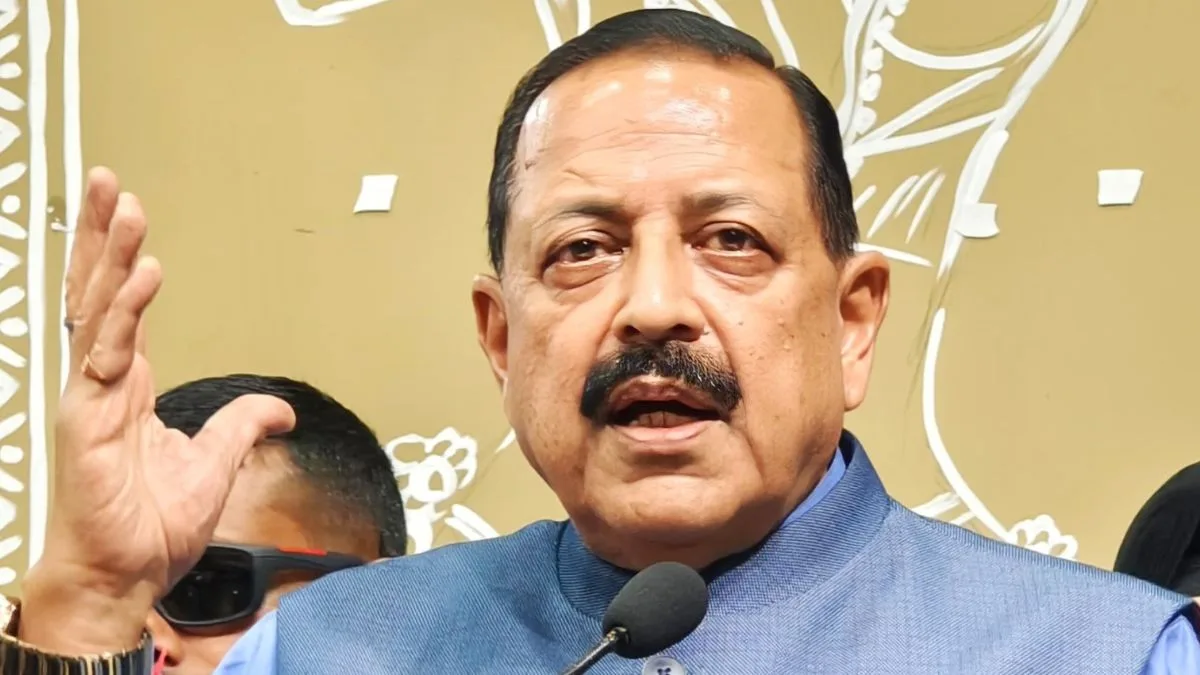
Union Minister of State for Science and Technology, Dr. Jitendra Singh, announced that Jammu & Kashmir (J&K) is set to be the torchbearer of India’s journey towards Destination 2047. This declaration came during the launch of the ATL Sarthi and Frontier Region Programme, a key initiative under the Atal Innovation Mission, at the University of Kashmir.
Dr. Singh highlighted that as India’s economy aims to elevate from the fourth to third rank globally, regions like J&K hold untapped potential. He remarked, “Jammu & Kashmir offers vast resources and opportunities that have not been fully explored, especially since Prime Minister Narendra Modi took office in 2014.”
The minister emphasized that J&K’s development started gaining momentum with governmental initiatives like the Aroma Mission, designed to harness the region’s natural resources.
In his address, Dr. Singh asserted that J&K can become a leading contributor to India’s innovation-led growth within the coming two decades. He celebrated the launch of the ATL Sarthi initiative, describing it as a dual achievement: enhancing Kashmir University’s role as a central player in India’s economic growth and extending AIM’s innovation network to this strategically significant Union Territory.
As part of the Frontier Region Programme, Dr. Singh announced the establishment of 500 new Atal Tinkering Labs (ATLs) across J&K. This initiative, representing the largest portion of 2,500 labs allowed for frontier areas, involves an investment of ₹100 crore aimed at providing students exposure to advanced technologies in fields such as robotics, 3D printing, and artificial intelligence.
Dr. Singh asserted that technology-driven sectors have propelled India’s economic growth, particularly in the realms of space and biotechnology. He noted, “India’s space economy has surged from nearly zero to $8 billion, with projections suggesting it will reach $40–45 billion within the next decade, spurred by over 400 active startups.”
Stress on collaboration between public and private sectors emerged as a critical theme during Dr. Singh’s speech. He explained that sustainable growth necessitates private involvement, citing successful initiatives like InSpace in space research and BIRAC in biotechnology as examples of effective structured collaboration.
The minister underscored the rising entrepreneurial spirit in J&K, specifically regarding the Aroma Mission, which has led to thousands of startups focused on lavender and floriculture. “Currently, around 3,500 lavender startups are thriving in the region, with many young individuals returning from corporate roles to pursue entrepreneurship,” he noted.
Dr. Singh shared inspiring statistics as well, revealing that 50 students from J&K ranked among the top 1,000 in a national School Innovation Marathon. He encouraged parents and students to realize that successful startups emerge not only in metropolitan areas but also in Tier 2 and Tier 3 cities, where nearly half of India’s startups now originate.
In closing his remarks, he stated, “As we envision India@2047, today’s students in these tinkering labs will be in their prime. They will serve as the torchbearers of a developed India, positioning J&K as pivotal in this national journey.”
The launch event also attracted significant attention, with notable figures such as Lieutenant Governor Manoj Sinha, Chief Minister Omar Abdullah, Education Minister Sakina Masood, University Vice-Chancellor Prof. Nilofer Khan, and AIM Mission Director Dr. Deepak Bagla in attendance.
